
My sister Julie was doing a bit of sorting out at the weekend and came across a World War 1 “Victory Medal” that had been awarded to our great uncle George Metelerkamp.
I love these unexpected links to “the ancestors”.
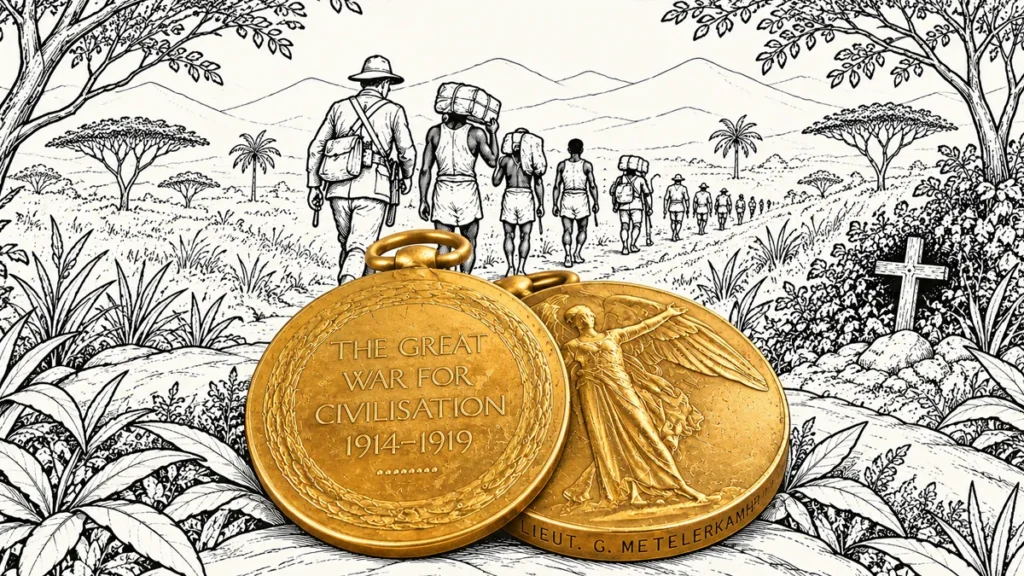
The medal glows bright like gold, but is actually bronze with a shiny finish. On one side is the figure of a winged woman depicting “Victory” and on the other is the inscription: “The Great War for Civilization 1914 – 1919”. Lt G Metelerkamp is stamped on the side.
Victory Medals were awarded to those who had served in the Allied Forces in World War 1.
Julie’s online search described it as “a profoundly poignant piece of history. Records indicate that your medal’s recipient tragically made the ultimate sacrifice during the Great War”.
George died in East Africa in 1917.
He was my grandfather’s brother, one of 12 children born to Peter Carl Metelerkamp and Johanna Rex, granddaughter of Knysna’s founder George Rex.
East Africa was still fairly wild and George was in the 2nd East Africa Road Corps established early in 1917 to build roads and bridges to move troops and supplies through the bush.
In many areas the only way to move supplies was by foot, and local people were forced, often violently, to act as porters. As the saying goes: When two elephants fight, it is the grass that gets trampled.
Porters far outnumbered fighting soldiers on both sides of the conflict in the East Africa Campaign. Conditions were often appalling, particularly at the German porter camp at Morogoro, 180km from Dar es Salaam, where 20,000 porters lived in 100 corrugated iron huts. Diseases like typhus spread fast and hundreds died.
There were local rebellions against this enforced labour, but they were soon quelled. Many Africans simply fled into the bush rather than be forced into porterage.
An estimated 300,000 porters died during WW1 from the harsh conditions and exploitation.
George died of enteric fever (typhoid) on 8th December 1917 at a place called Mtandawala, a temporary military hub in the bush in southern Tanzania. Typhoid was rampant because of contaminated water and he and many others would have been buried at the field hospital.
The Commonwealth War Graves Commission tried to track down the thousands of isolated graves in East Africa, an impossible task in an area the size of Germany and France combined. About 1000 were found and reburied, but George was not among them.
As one website said, unlike the trench warfare in Europe in WW1, the war in East Africa was more like guerilla warfare with rapid movement of troops through hundreds of kilometres of bush, swamp and jungle. The dead were buried where they died, and these graves were “quickly swallowed back by the jungle”.
This was probably also the fate of the graves of the 300 000 porters who died across East Africa.
Lt George Metelerkamp is officially commemorated at the Dar es Salaam War Cemetery with others whose graves were never found.
But his bones lie forever in an unknown grave in the bush of southern Tanzania.