
I have always been fascinated by survival stories.
When rescue workers in Nepal found a man alive in a tunnel 10 days after the devastating floods that swept away roads, bridges and killed at least 1300 people, I wondered how he had managed to survive so long.
Sanjay Sah, 30, a mechanical foreman at Nepal’s Trishuli hydropower project, had been trapped in a pitch dark, collapsed tunnel, waist deep in water.
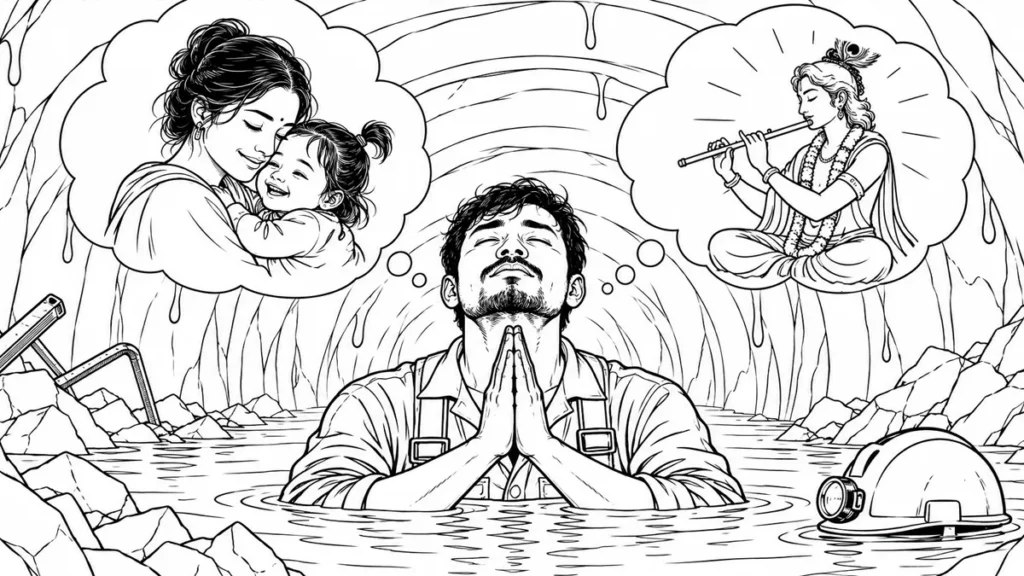
Sanjay told Reuters that he knew every inch of the tunnel, but after the flood it was so completely transformed he could not find his way out. He decided to stay put and wait for help.
Thoughts of his wife and two-year-old daughter gave him strength and he felt he should not give in to panic.
“So I kept reciting God’s name and praying.” He recited the Hare Krishna mantra – a repetitive chant where the same few words are said over and over – for the entire 10 days.
“The mantra gave me a different kind of feeling, almost a spiritual experience. I wasn’t afraid. Instead I felt calm and relaxed,” he told Reuters.
Astonishingly, he told rescuers he thought he had been stuck in the tunnel for only two or three days.
I wondered if there were a link between chanting the mantra and his survival. It appears there is.
Most of us know how fear triggers our “flight or fight” response: an adrenalin surge increases the heart rate and directs blood to the major muscles for fast action. Pain is suppressed and the brain is hyper alert.
But when a person is in a drawn-out high-stress situation, like surviving a disaster but not knowing if you will ever be rescued, it’s a different story. Being on high-alert for a long time can lead to muscle breakdown and cause changes in the brain that affect the rational thinking we need to stay alive.
Research has found in this kind of situation repeating “rhythmic formulas” – like saying a rosary, chanting a mantra, repeating the Lord’s Prayer – has an amazing effect on fear. It slows down the heart rate, stabilises blood pressure, and shifts brain waves away from those associated with anxiety and panic to those associated with relaxation. It creates a “mental anchor”.
As one website said: “By intentionally filling the mind with a rhythmic, predictable sequence, these survivors lock the door against fear.”
Quite extraordinary.
This state of mind also slows down our perception of time, which is why Sanjay thought he had been trapped for only two or three days instead of 10.
There are survival stories about people who were not religious, but who created “mental anchors” by undertaking repetitive mental tasks.
World War 2 air force Captain Louis Zaperini survived drifting in a raft for 47 days by forcing his two crewmates to do mental exercises: making them recall their mothers’ recipes step-by-step, describing every room in their childhood homes or solving mathematical equations.
The brain is truly astonishing.
As neurologist Richard Restak said: “How can a three-pound mass of jelly imagine angels, contemplate the meaning of infinity and even question its own place in the cosmos?”